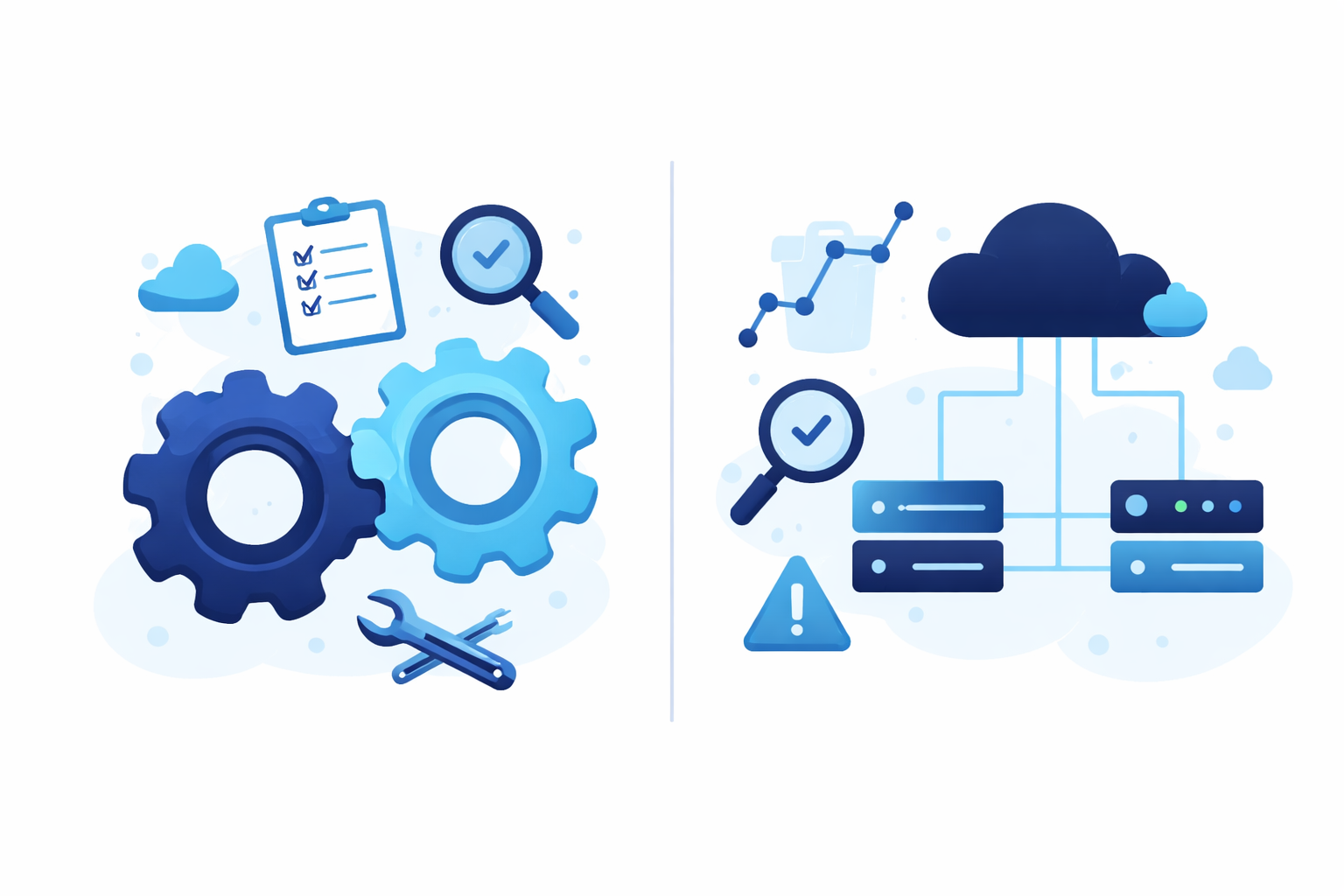
What is SRE? DevOps vs SRE Explained + How to Become a Site Reliability Engineer in 2026
Site Reliability Engineering (SRE) is the practice of applying software engineering principles to operations to build highly reliable, scalable systems. DevOps focuses on speed and collaboration; SRE focuses on reliability and measurable stability using SLIs, SLOs, SLAs, and Error Budgets. If you want to become an SRE in 2026, you must first master DevOps fundamentals like Linux, cloud, CI/CD, containers, and Kubernetes. SRE is not a shortcut, it is an advanced evolution of DevOps.
A Simple Story Before We Start
It’s 11:40 PM.
You’re still in the office because a production deployment failed. The rollback worked, but not cleanly. Some background jobs are stuck. Monitoring dashboards are noisy. Slack is full of messages. Everyone is waiting for confirmation that production is stable.
Your office cafeteria closed two hours ago.
So you open your favorite food delivery app.
You’re exhausted. You’re hungry. You just want something simple.
The app doesn’t crash.
It just keeps loading.
10 seconds. 15 seconds. 20 seconds.
You refresh. Still slow.
At that moment, you don’t care about loyalty points. You don’t care about ₹20 discount. You don’t care about brand.
You switch to another app.
That silent switch is what businesses fear in 2026.
Modern systems don’t lose users only because of catastrophic outages. They lose users because of latency, instability, degraded performance, and unpredictable behavior.
Users don’t complain. They leave.
And that is exactly why Site Reliability Engineering (SRE) has become one of the fastest-growing and most searched roles in technology.
Search trends around terms like “What is SRE”, “DevOps vs SRE”, “How to become a Site Reliability Engineer”, “SRE roadmap 2026”, and “SRE salary in India” have increased dramatically because organizations now understand one harsh reality:
Speed without reliability destroys trust.
Let’s break this down properly, technically, practically, and from a career perspective.
What is SRE? (Site Reliability Engineering Explained Clearly)
SRE stands for Site Reliability Engineering.
It is a discipline that applies software engineering principles to infrastructure and operations, with the goal of building highly reliable and scalable systems.
Instead of managing infrastructure manually, SRE teams use code, automation, and measurement to engineer reliability into systems.
The core philosophy of SRE is simple:
If humans are repeatedly fixing the same problem, automate it.
SRE transforms operations from reactive firefighting into proactive engineering.
In modern organizations, SRE ensures that applications meet defined reliability targets while allowing product teams to innovate at speed.
Why SRE Became Critical in 2026
Technology stacks are no longer simple.
Applications now run on:
Distributed microservice
Kubernates clusters
Multi-cloud environments
Global CDNs
Real-time data pipelines
AI-driven systems
Each additional layer increases complexity.
And complexity increases the probability of failure.
The question is no longer:
“Will the system fail?”
The real question is:
“How quickly can we detect, diagnose, and recover from failure?”
That shift in mindset is what makes SRE essential.
DevOps vs SRE – What’s the Real Difference?
One of the most searched comparisons in the industry today is “DevOps vs SRE.” Many engineers assume they are the same role with different titles. They are not.
DevOps is primarily a cultural and automation-driven approach. It focuses on collaboration between development and operations teams, continuous integration and continuous delivery (CI/CD), Infrastructure as Code, and shortening the software delivery lifecycle.
SRE, or Site Reliability Engineering, is a reliability-first implementation model. It introduces strict measurement, engineering discipline, and mathematical thinking into production environments.
DevOps asks: How can we ship faster and safer?
SRE asks: How reliable is the system, and how much failure can we afford?
Another way to understand the difference between DevOps and SRE is through accountability.
DevOps improves processes and tooling. SRE defines reliability targets and enforces them using SLIs, SLOs, and error budgets.
For example: A DevOps engineer may build a CI/CD pipeline that deploys 20 times a day. An SRE will evaluate whether those deployments are consuming the error budget and impacting system stability.
SRE is not a replacement for DevOps. It is an evolution built on top of DevOps foundations. Without understanding CI/CD pipelines, containerization, Kubernetes orchestration, cloud networking, and infrastructure automation, SRE practices cannot be implemented effectively.
If DevOps builds and ships the system, SRE ensures it survives production at scale.
Core Reliability Concepts in SRE
If you want to rank for high-volume SRE keywords, you must deeply understand SLIs, SLOs, SLAs, and Error Budgets. These are foundational concepts in Site Reliability Engineering.
What is an SLI (Service Level Indicator)?
A Service Level Indicator (SLI) is a measurable metric that reflects system performance.
Common SLIs include:
Request latency
Availability percentage
Error rate
Thoughput
An SLI answers the question:
“How is the system performing right now?”
It is the raw measurement of reliability.
What is an SLO (Service Level Objective)?
A Service Level Objective (SLO) defines a target value for an SLI. Examples:
99.9% monthly uptime
95% of requests under 300ms
Less than 0.1% of error rate
SLO defines what level of reliability is acceptable.
It balances business goals with engineering reality.
SLO answers:
“What level of performance are we aiming to maintain?”
What is an SLA (Service Level Agreement)?
A Service Level Agreement (SLA) is a formal external commitment
based on SLOs. It often includes financial penalties if violated.
While SLO is internal engineering guidance, SLA is a business contract.
SLA answers:
“What are we promising customers?”
What is an Error Budget?
Error Budget is one of the most powerful and misunderstood concepts in SRE.
If your SLO is 99.9% uptime, you are allowed 0.1% downtime within a defined period.
That 0.1% is your error budget.
This transforms reliability into a measurable trade-off.
If the system is stable and you have error budget remaining, teams can deploy aggressively.
If the error budget is exhausted, engineering must pause feature releases and prioritize stability.
Error Budgets create alignment between product velocity and system reliability.
Instead of emotional debates, teams use data
What is Observability in SRE ?
Observability is one of the most critical and high-search concepts associated with Site Reliability Engineering.
Many engineers confuse monitoring with observability. They are not the same.
Monitoring tells you when something is wrong. Observability helps you understand why it is wrong.
In distributed systems built on microservices and Kubernetes, failures are rarely obvious. A single slow database call can cascade into system-wide latency. Without deep visibility, troubleshooting becomes guesswork.
Observability in SRE is built on three pillars: Logs, Metrics, and Traces
Logs
Logs are structured or unstructured time-stamped event records generated by applications and infrastructure.
They provide granular insight into system behavior, exceptions, and state changes.
Logs answer: What exactly happened?
However, logs alone are insufficient at scale because modern systems generate massive volumes of data.
Metrics
Metrics are numerical values aggregated over time.
That distinction is fundamental in modern SRE practices.
How to Become a Site Reliability Engineer in 2026 (Step-by-Step Roadmap)
If you are serious about the SRE career path, you need a structured roadmap. Becoming a Site Reliability Engineer is not about collecting tools. It is about building layered competence.
Step 1: Master Linux and Networking
Every strong SRE understands operating systems deeply. You must know how processes work, how memory is managed, how networking flows through TCP/IP, how DNS resolution works, and how load balancers distribute traffic. Without strong system fundamentals, troubleshooting production incidents becomes guesswork.
Step 2: Learn Cloud Architecture
Modern SRE roles operate in cloud-native environments. Whether it is AWS, GCP, or Azure, you must understand virtual networks, auto-scaling groups, IAM, managed databases, and high-availability architecture.
Cloud knowledge is not optional for SRE in 2026.
Step 3: Build Strong DevOps Foundations
Before transitioning into SRE, you must master DevOps fundamentals:
CI/CD pipeline design
Docker and containerization
Kubernetes architecture
Infrastructure as Code (Terraform or similar tools)
Git workflows and automation
SRE assumes you already know how systems are deployed
Step 4: Learn Observability and Monitoring Tools
Hands-on experience with Prometheus, Grafana, logging stacks, and distributed tracing systems is essential.
Understanding how to define meaningful SLIs from raw metrics separates average engineers from strong SREs.
Step 5: Build Strong DevOps Foundations
This is where SRE becomes distinct from DevOps.
You must practice defining SLOs, calculating error budgets, conducting blameless postmortems, and designing high-availability systems.
Reliability is not achieved accidentally. It is engineered deliberately.
Step 6: Automate Everything
Learn Python or Go.
If a task repeats, automate it.
If an incident occurs twice, design it out of the system.
SRE is not about firefighting. It is about building systems that rarely require firefighting.
SRE Skills Required in 2026
A strong Site Reliability Engineer combines
Linux expertise
Cloud archieture knowledge
CI/CD implementation
Kubernates operations
Observability practices
Automation scripting
Incident management discipline
clear communication skills
Technical depth and calm decision-making under pressure are critical.
Globally: - $120,000 to $180,000+ depending on region and experience
Salaries reflect the responsibility carried by SRE roles.
Is SRE Better Than DevOps?
SRE is not better than DevOps.
SRE is an advanced specialization built on DevOps foundations.
If you are early in your career, focus on mastering DevOps first.
Only after building strong automation, cloud, and CI/CD expertise should you transition into SRE.
Skipping foundations leads to fragile understanding.
Frequently Asked Questions (FAQs)
DevOps focuses on collaboration, automation, and faster software delivery. SRE focuses on reliability engineering using measurable targets like SLIs, SLOs, and error budgets.
Yes. As cloud adoption, distributed systems, and uptime expectations increase, Site Reliability Engineer roles continue to grow globally.
SRE is typically not an entry-level role. Most engineers transition into SRE after gaining strong DevOps or infrastructure experience.
Python and Go are commonly used for automation, tooling, and reliability engineering tasks.
With consistent learning and hands-on practice, 2–4 years of DevOps or infrastructure experience is typically required before transitioning.
Certifications can help validate knowledge, but hands-on experience in production systems matters more than certificates.
Common SRE tools include Kubernetes, Terraform, Prometheus, Grafana, ELK stack, cloud-native monitoring systems, and automation frameworks.
Final Thoughts: Your Path to Becoming a Site Reliability Engineer in 2026
In 2026, reliability is not a luxury. It is a business requirement.
Companies no longer compete only on features. They compete on uptime, latency, stability, and user trust.
A slow system loses users. An unstable system loses revenue. An unreliable system loses reputation.
Site Reliability Engineering exists because modern systems are too complex to manage without discipline, measurement, and engineering rigor.
But here is the most important takeaway from this entire guide:
SRE is built on DevOps.
You cannot engineer reliability if you do not understand how systems are built, deployed, automated, and scaled.
If you are new to DevOps and want to build strong fundamentals first, start here: 👉 Read our complete guide How to Become a DevOps Engineer in 2026 If you already understand DevOps and want to transition into SRE with structured, production-focused learning, advanced observability, reliability engineering, SLIs/SLOs, and real-world scenarios, explore our dedicated program here: