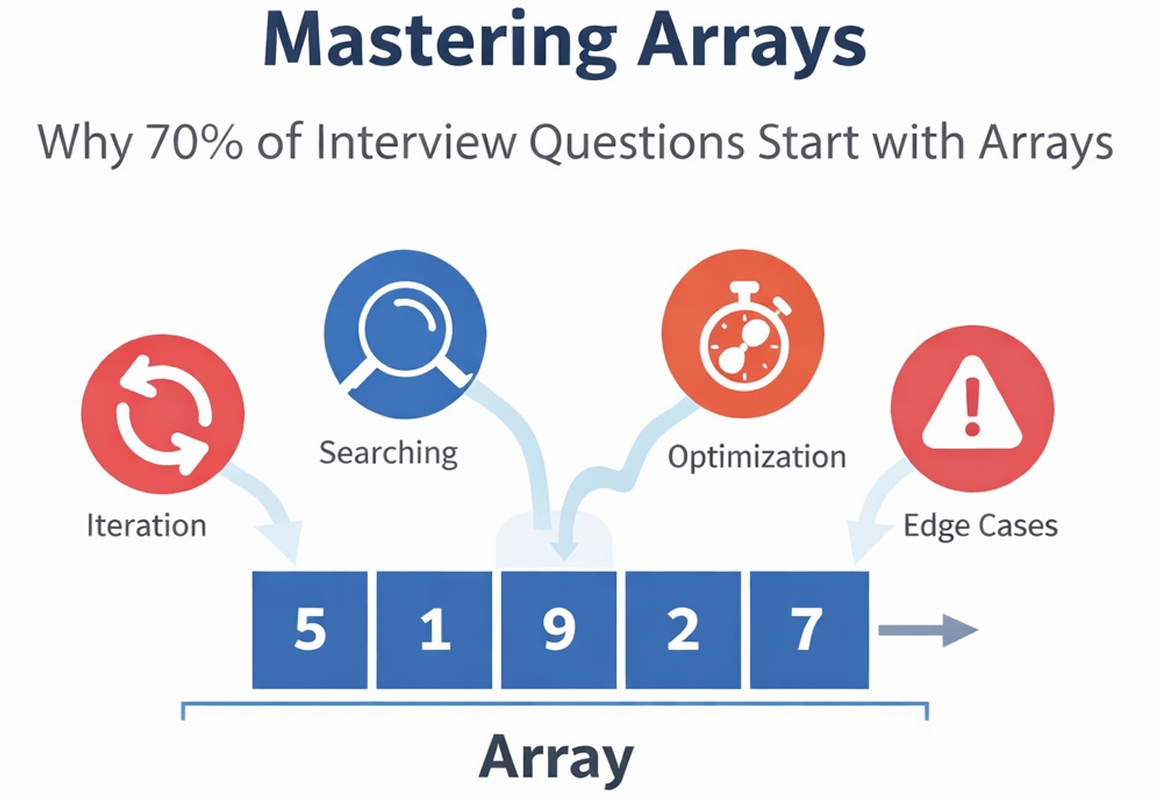
If you review coding rounds at top product-based companies, you’ll notice something consistent: arrays appear everywhere.
Sometimes directly.
Sometimes disguised inside another problem.
Arrays aren’t just a beginner topic. They form the backbone of algorithmic thinking. Strong array fundamentals translate into better optimization, cleaner logic, and faster debugging in interviews.
This guide focuses on what actually matters for candidates preparing for interviews - not theory for the sake of theory.
Why Arrays Are Interview Gold
Arrays test multiple skills simultaneously:
- Iteration control
- Logical structing
- Complexity analysis
- Optimization instincts
- Edge case handling
Because arrays are simple in structure but rich in patterns, they help interviewers evaluate how you reason and refine solutions.
Core Array Fundamentals You Must Be Fluent In
1. Constant-Time Access
Array indexing gives O(1) access. That means you can retrieve or update any element instantly using its index. If your solution repeatedly searches for elements that could have been tracked while iterating, that signals inefficiency. Understanding when access is constant and when traversal is required is fundamental.
2. Traversal Defines Complexity
Most array problems revolve around iteration strategy. Common traversal styles:
- Single pass → O(n)
- Nested loops → O(n²)
- Two pointers → O(n)
- Sliding window
Your choice of traversal determines scalability. A nested loop may be acceptable for small input sizes. But if constraints allow 10⁵ elements, you must aim for linear or near-linear solutions.
Interview tip: Always state complexity explicitly.
3. Structural Cost of Modification
Arrays store elements contiguously, so inserting or deleting in the middle requires shifting elements. That’s an O(n) operation.
This matters in rearrangement problems. If your solution involves frequent shifting, reconsider your approach. Efficient solutions often avoid unnecessary movement and instead use pointer manipulation or swapping.
High-Impact Array Patterns for Interviews
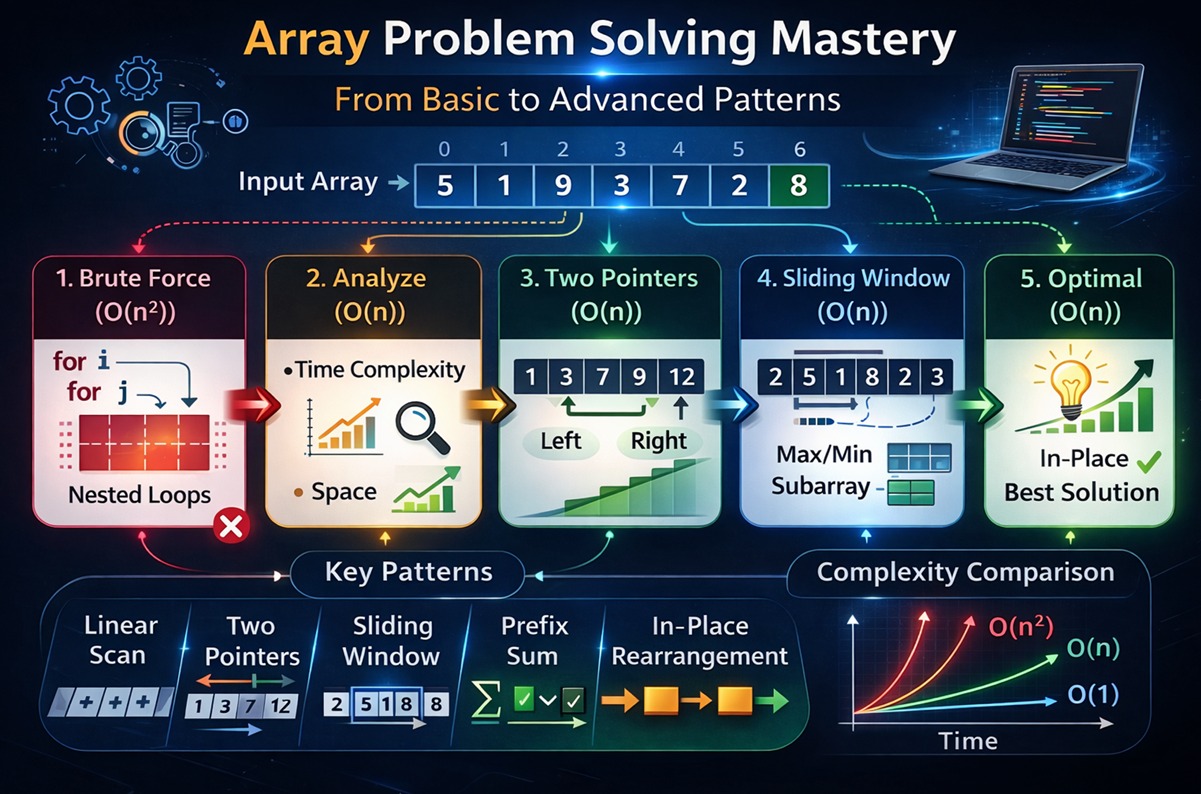
Instead of memorizing problems, master these patterns. Most array questions are variations of them.
1. Linear Scan
Used for:
- Max/min finding
- Frequency counting
- Validity checks
These problems test clarity and correctness. Code must be clean and handle edge cases properly.
2. Two Pointers
Applied when:
- The array is sorted
- You're searching for pairs
- You're reducing comparisons
Instead of checking every pair with O(n²), two pointers reduce it to O(n) by leveraging order. This pattern appears frequently in product-based interviews.
3. Sliding Window
Used for:
- Longest/shortest subarray
- Fixed-size window compuytations
- Dynamic range tracking
The key idea is maintaining a running window and adjusting boundaries without recomputing everything. It often transforms quadratic solutions into linear ones.
4. Prefix-Based Questions
When a problem requires repeated range calculations, precomputing cumulative values can dramatically improve efficiency. This avoids recalculating the same information multiple times and leads to cleaner, faster logic.
5. In-place Rearrangement
Examples includes
- Partitioning elements.
- Moving elements based on conditions.
- Reordering without extra space
These problems test index control and swap discipline. Small pointer mistakes here can break logic.
How to Approach Array Problems in Interviews
Here's a practical flow you can follow:
Step 1: Define a Working Solution
Even if it's not optimal, outline a correct approach. This shows understanding.
Step 2: Analyze Complexity
Identify time and space usage. If complexity doesn't align with constraints, say so.
Clear statements like: “This approach runs in O(n²), which may not scale for large inputs.” demonstrate awareness.
Step 3: Identify Bottlenecks
Ask:
- Where is repeated work happening?
- Can I reduce nested loops?
- Can I track information dynamically?
Optimization usually comes from eliminating redundancy.
Step 4: Apply a Recognized Pattern
Transition to a structured improvement:
- Replace nested loops with two pointers.
- Convert repeated computation into running instances
- Reduce passes over the array
Explain how the new approach improves complexity. .
Common Mistakes in Array Interviews
- Ignoring edge cases
- Off-by-one errors
- Incorrect pointer updates
- Forgetting to analyze complexity
- Stopping at brute force
Even experienced candidates lose points on small implementation errors. Precision matters.
Pattern Recognition (Without Memorization)
When I was preparing for interviews, I focused heavily on advanced topics like graphs and dynamic programming. But during real interviews, I noticed something - many “medium” questions were just optimized array problems.
The difference wasn’t knowledge of advanced algorithms. It was the ability to refine a basic solution under constraints.
Once I deliberately practiced the two pointer transitions, window adjustments and clean complexity articulation, my performance improved significantly. Arrays stopped feeling basic and started feeling strategic.
Why Arrays Build Strong Engineers
Mastering arrays stengthens:
- Iteration logic.
- Complexity intuition.
- Optimization thinking.
- Clean implementation habits.
These skills transfer directly to more advanced data structures. Arrays are not the simplest topic - they are the most foundational one.
What to do next ?
To prepare efficiently:
- Practice linear scan problems.
- Master two pointers.
- Understanding sliding windows deeply.
- Get comfortable with prefix-based thinking.
- Solve re-arrangement problems in-place.
Build depth. Think systematically. Optimize consciously. That’s how you truly master arrays for interviews.
contact codekerdos